In short
Up to 40% of a typical media archive is duplicate content, and new duplicates (versions) keep entering the supply chain at ingest. Version intelligence finds them, helps stop new ones arriving, and keeps the saving permanent.
FinOps teams already control the obvious cloud costs. The one they often miss is paying repeatedly for content that already exists somewhere else in the supply chain.
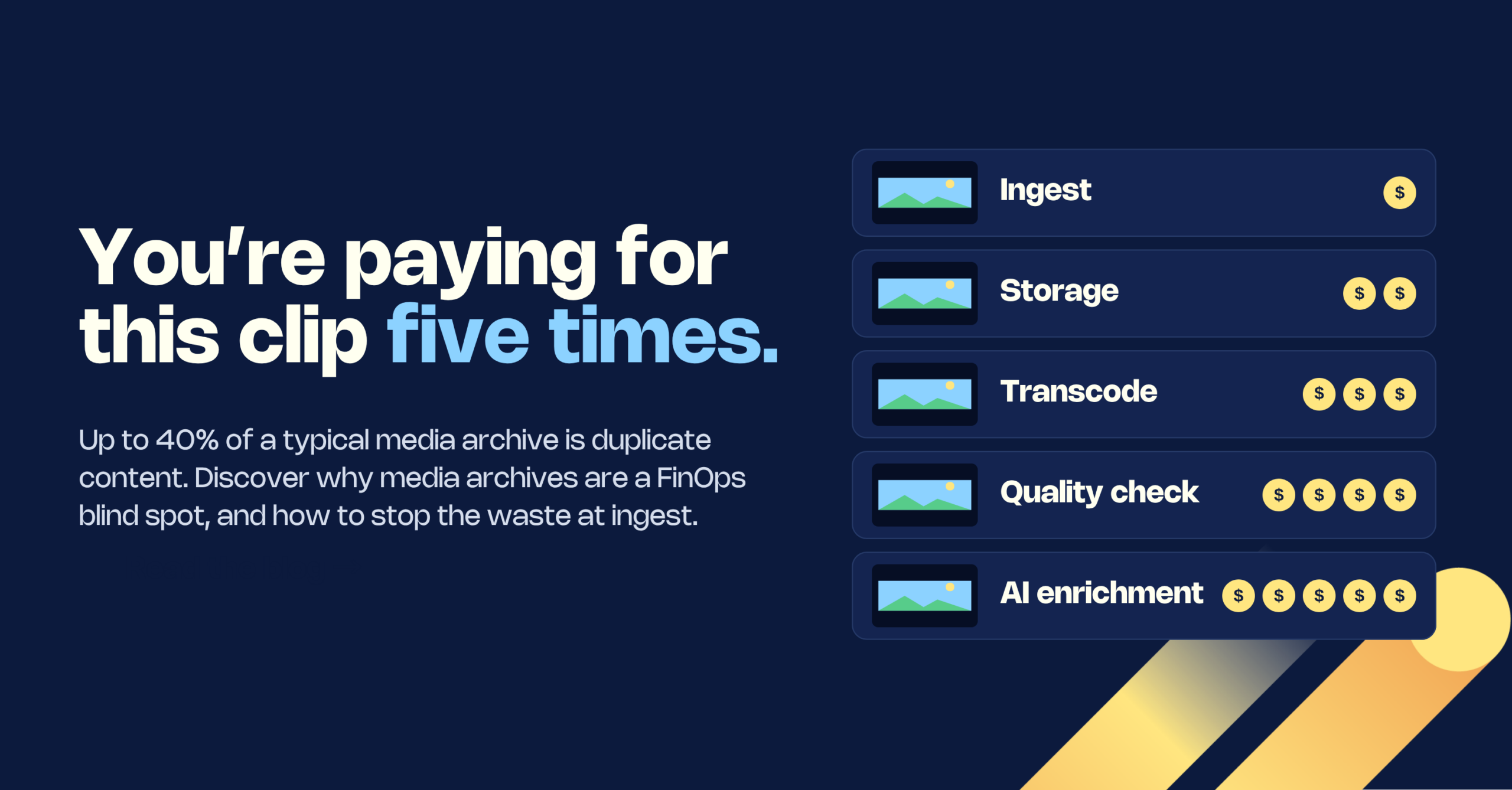
The archive is where this waste is easiest to see, but it starts earlier. Unnecessary versions enter at ingest through deliveries, re-conforms, regional variants and format conversions. They are then stored, transcoded, quality checked and enriched before anyone notices. The Lab tackles this with version intelligence: a clear understanding of how every version of a piece of content relates to every other.
Inform: see the waste
“Cost dashboards show what you spend, not whether the spend was needed”
Every duplicate looks like legitimate spend, because a storage system can’t tell it is redundant. The Lab is Snicket Labs’ content intelligence suite, and its Match & Compare capability fingerprints content to spot duplicates across format, codec, resolution and clip length. FinOps teams can finally see how much they pay for the same content twice (or more), and where it came from.
Optimise: stop it at the door
Deduplication typically cuts cloud storage costs by up to 40%. Every month a duplicate stays in storage, you pay for it again. The same goes for AI: each duplicate sent through an enrichment pipeline is processed a second or third time, and you gain nothing from it.
Clean-up alone isn’t enough, though. If new duplicates keep arriving, the archive refills. By checking content at ingest, teams can decide whether a file is genuinely new, a meaningful new version, or an unnecessary copy that should never be stored or processed. A duplicate caught at ingest avoids the storage, processing and AI costs that every later stage would have added. One caught in the archive has already been paid for several times.
Operate: the numbers
One enterprise proposal modelled $11.7M of savings over five years against a $2.5M contract, a 4.6x return, assuming 25% of the archive is duplicate. The model shows the contract cost recovered within the first year. A smaller single-year proposal modelled a 2.65x return, with payback in just under two years. Both models also tested 15% and 40% deduplication rates, so the results don’t rely on a best case.
These figures rest on assumptions about what the customer pays for its infrastructure, such as storage tiers, cloud rates and AI processing costs, so actual savings will vary with each organisation’s own costs. Surfacing hidden footage also has the potential to open up new revenue streams.
The benefits reach beyond the invoice. Creative teams find the verified asset in seconds, finance sees where budgets are draining, and engineers can use The Lab’s Match & Compare API to build rules-based ingest workflows.
The FinOps takeaway
The biggest invisible cost in a media business is rarely an oversized cloud server or instance. It is the steady flow of unnecessary versions through the supply chain, paid for again at every stage. Cleaning the archive is a strong first win, but version intelligence at ingest fixes the cause and makes the saving last. Put a control point at ingest, and measure version waste like any other cost.